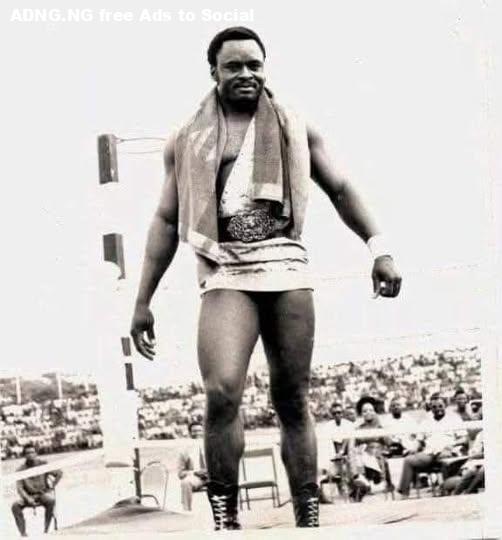
Power Mike: The Nigerian Giant Who Took on the World
In the heart of Neni, Anambra State, a boy named Michael Okpara was born in August 1939. No one knew then that he would grow into one of Africa’s most celebrated wrestlers, earning the name Power Mike—a man whose strength and skill would bring pride to Nigeria and awe to the world.
Like many young men of his time, Power Mike left his village in 1952 for Onitsha, hoping to learn the ropes of business. But fate had a different plan. While in Onitsha, he stumbled upon the Dick Tiger Boxing Club, where he trained as a middleweight boxer under the legendary Dick Ihetu Tiger, a man who would become his role model. That was where the fire of combat sports was lit in his heart.
The Journey to Greatness
By 1961, Power Mike had begun touring Nigeria, showcasing his strength and fighting skills in places like Onitsha, Enugu, Aba, Port Harcourt, Lagos, Jos, and Kaduna. The crowds loved him. His name spread like wildfire, and his reputation as a fierce fighter grew.
But he wasn’t done. In 1964, he took his talent to Ghana, defeating several opponents and earning the respect of wrestling fans across West Africa. Three years later, in 1967, he expanded his conquest to Côte d’Ivoire and Senegal, before finally setting his sights on Europe, where the competition was tougher, the stage bigger, and the stakes higher.
It was in Sweden that he signed his first major contract in 1967, proving himself against some of the world’s best fighters. From there, he moved to Greece, becoming a professional wrestler and taking down every opponent who stepped into the ring with him.
The Champion of Africa
Power Mike’s biggest moment came in 1970, when he returned to Africa and defeated Gambia’s Massambula, becoming the African Heavyweight Wrestling Champion. The whole continent celebrated him—he was a Nigerian hero, an African warrior, a champion who had made his people proud.
His victories didn’t stop there. In 1973, he took down Ali Baba of Lebanon and later humbled Johnny Kwango in Lagos, cementing his place as one of the greatest wrestlers Africa had ever produced.
Beyond the Ring
By 1976, Power Mike knew it was time to leave the ring, but he wasn’t walking away from wrestling entirely. Instead, he turned to promoting the sport internationally, helping other young African fighters find a place on the world stage.
Even though he left the ring, the legend of Power Mike never faded. His name echoed in songs, like the hit track by Okonkwo Asaa, which praised his strength and accomplishments.
A Legacy That Lives On
In 2004, at the age of 64, Power Mike passed away. But legends don’t die—they live on in stories, in memories, and in the hearts of those they inspired.
Power Mike wasn’t just a wrestler; he was a symbol of strength, resilience, and African pride. He showed the world that a boy from Neni could rise to global fame with sheer determination and unbreakable spirit. He remains one of Nigeria’s greatest sports icons, a true warrior who took on the world—and won.
In the world of wrestling and strength sports, few names resonate with the same legendary status as Michael Okpala, famously known as Power Mike. A towering figure in Nigeria’s sporting history, Power Mike was not just an athlete; he was a national icon who put Nigeria on the global map in the wrestling arena.
The Making of a Champion
Born in the 1940s in Nigeria, Power Mike’s journey into the world of strength and wrestling was driven by determination and a natural affinity for physical prowess. His early days saw him venturing into weightlifting and bodybuilding before he transitioned into professional wrestling, where he truly made his mark.
With a physique that commanded attention and strength that defied expectations, Power Mike quickly gained fame across Nigeria and beyond. He was known for his ability to lift extraordinary weights, perform jaw-dropping feats of strength, and take on some of the biggest names in the wrestling world.
Taking on the World’s Best
During the 1960s and 1970s, Power Mike took his skills beyond Nigeria, challenging top wrestlers in Europe, America, and Asia. He faced off against world-renowned opponents, including wrestling giants like Mil Máscaras, Johnny Kwango, and Mighty Igor. Despite coming from a country with little international wrestling recognition at the time, he held his own against seasoned fighters, earning a reputation as a formidable contender.
His wrestling career was not just about personal achievement but also about national pride. Nigerians saw in Power Mike a symbol of resilience and strength—someone who could stand toe-to-toe with the world’s best and not back down.
Returning Home to Build a Legacy
After years of international competition, Power Mike returned to Nigeria, where he focused on promoting wrestling and bodybuilding. He established the Power Mike Wrestling Promotion, which played a crucial role in developing local talent and popularizing wrestling in Nigeria. Through his efforts, wrestling became a significant sport in the country, inspiring a new generation of athletes.
Beyond wrestling, Power Mike ventured into business and entertainment, proving that his strength extended beyond the ring. He became a successful businessman, running a chain of fitness centers and promoting various sporting events.
A Lasting Impact
Power Mike passed away in 2004, but his legacy remains unshaken. His contributions to Nigerian sports, his role in promoting wrestling, and his impact on youth development continue to be celebrated. Today, he is remembered as a trailblazer who took Nigerian wrestling to the world stage and proved that African athletes could compete at the highest levels.
In a time when Nigerian wrestling was largely unheard of, Power Mike became a giant—both in physique and in influence. His story is one of perseverance, courage, and the unbreakable spirit of a true champion.